
Almost everyone has said or done something in the heat of the moment and later regretted it. A harsh text message, an impulsive purchase, an angry outburst, a sudden breakup, or the decision to quit a job during a stressful period are all examples of impulsive behavior.
To some extent, impulsivity is a natural part of being human. However, for some individuals, it becomes a habitual way of responding to life’s challenges and begins to significantly affect relationships, career success, emotional well-being, and overall quality of life.
Impulsivity is often viewed as a lack of self-control or willpower. Modern psychology, however, offers a much deeper understanding. In many cases, impulsive behavior is an attempt to quickly escape emotional discomfort.
Research suggests that impulsivity is associated with a wide range of psychological difficulties, including anxiety, substance misuse, relationship problems, and emotional dysregulation. Studies have estimated that difficulties with impulse control contribute to a significant proportion of mental health concerns and risk-taking behaviors across the lifespan.
What Lies Beneath Impulsivity?
Contrary to popular belief, impulsive actions rarely appear out of nowhere. They are often preceded by emotional distress that has been building over time and that the individual may not fully recognize or know how to regulate effectively.
Irritability may sometimes reflect a deeper sense of powerlessness. In other situations, anger can mask a fear of rejection or abandonment. Likewise, dramatic behavior often stems from a strong need for connection, validation, or acceptance. For some individuals, a sudden breakup may be driven by anxiety about potential emotional pain.
As emotional tension increases, people naturally look for ways to relieve it. In those moments, emotions can override the ability to think clearly, evaluate consequences, and respond thoughtfully.
The challenge is that impulsive actions often provide immediate relief. The emotional pressure temporarily decreases, but the long-term consequences frequently create new problems that become additional sources of stress.
As psychiatrist and mindfulness researcher Jon Kabat-Zinn famously observed:
“You can’t stop the waves, but you can learn to surf.”
In many ways, learning to manage impulsivity involves developing the ability to experience difficult emotions without immediately acting on them.
Why Are Some People More Impulsive Than Others?
Many factors contribute to impulsive behavior, but early life experiences often play a significant role.
Children who grow up in environments where emotions are ignored, criticized, dismissed, or viewed as weaknesses may never fully learn how to identify and regulate their emotional experiences. As adults, they may continue to experience strong emotions as overwhelming or threatening and seek immediate ways to reduce their discomfort.
Impulsivity is also commonly associated with childhood environments characterized by criticism, unpredictability, high expectations, emotional neglect, or inconsistent caregiving. Over time, individuals may develop core beliefs such as:
- “Nobody understands me.”
- “People will eventually reject me.”
- “I need to protect myself first.”
- “If I make a mistake, I will lose my worth.”
- “I am not good enough.”
During stressful situations, these beliefs can become activated automatically, triggering emotional reactions that seem disproportionate to the actual event.
Impulsivity may also intensify under conditions such as chronic stress, burnout, sleep deprivation, relationship conflict, financial difficulties, substance use, or unresolved psychological trauma.
How Does Impulsivity Show Up?
Impulsivity does not always look like obvious anger or aggression.
Some people abruptly end relationships after relatively minor disagreements. Others engage in impulsive spending to cope with anxiety, loneliness, or emotional emptiness. Some turn to alcohol, overeating, or other forms of emotional avoidance. For others, impulsivity may appear as a pattern of constantly changing jobs, partners, goals, or life directions.
Impulsive behavior is often followed by regret. Once the emotional intensity subsides, people frequently recognize that their actions were excessive or unhelpful. Unfortunately, by that point, the consequences may already have occurred.
Many clients describe the experience in remarkably similar ways:
“At that moment, it felt like I had no other choice.”
Yet this feeling of having no choice is often an illusion created by intense emotional activation.
One of the Most Effective Tools for Managing Impulsivity
Many people assume impulsive behavior happens instantly. In reality, there is almost always a step between an event and a reaction: our thoughts and interpretations.
Cognitive Behavioral Therapy (CBT) often explains this process through a simple sequence:
Situation → Thought → Emotion → Action → Consequence
Consider the following example.
Situation:
A manager sends a message saying:
“We need to discuss the results of the project.”
Automatic Thought:
“I messed everything up. I’m about to be criticized.”
Emotion:
Anxiety, shame, irritation.
Impulsive Reaction:
The employee becomes defensive, sends an emotional message, or starts arguing before the conversation even takes place.
Consequence:
The relationship deteriorates, anxiety increases, and feelings of guilt emerge.
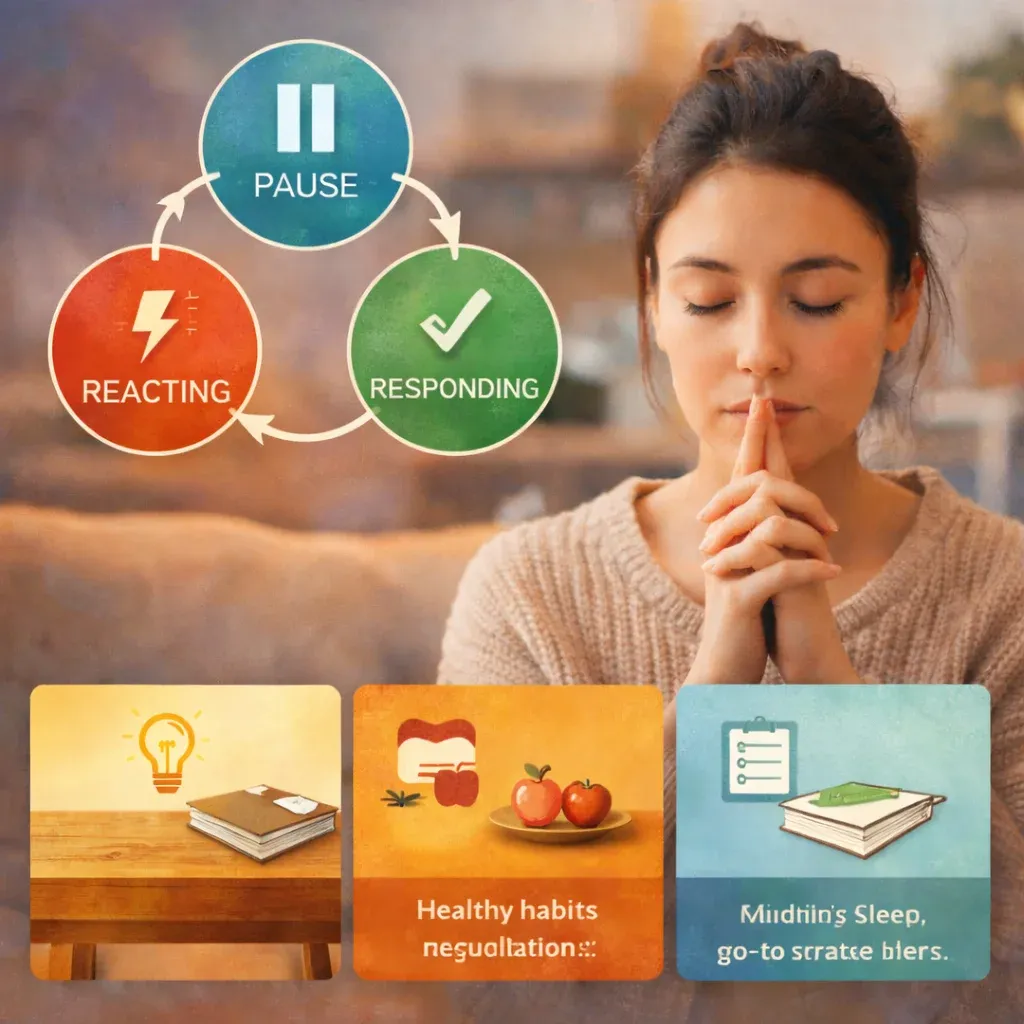
One of the most powerful CBT techniques for impulsivity is called Pause and Check the Facts.
Before reacting, ask yourself:
What actually happened?
Focus only on the facts.
What assumptions am I making?
Identify the conclusions your mind is automatically generating.
What other explanations are possible?
Consider alternative interpretations.
In the example above, the only fact is that the manager requested a discussion. Everything else is an assumption.
Even a pause of one or two minutes can significantly reduce the likelihood of an impulsive reaction.
Research on emotional regulation consistently shows that even brief delays between emotional activation and behavioral response can improve decision-making and reduce reactive behavior.
The 24-Hour Rule
Another practical tool frequently used in psychotherapy is the 24-Hour Rule.
If the decision involves:
- quitting a job;
- ending a relationship;
- making a major purchase;
- sending an emotional email or message;
- posting on social media;
- engaging in a serious conflict;
it is often wise to delay the final decision for at least 24 hours following a strong emotional reaction.
During periods of emotional activation, our perspective becomes narrower. Everything feels urgent, threatening, and in need of immediate action.
Several hours later—or the next day—the emotional intensity often decreases, allowing for more balanced thinking.
A useful question to ask yourself is:
“Will this decision still support my goals in a month? In a year?”
This simple question helps shift attention from immediate emotional relief toward long-term well-being.
A Clinical Example
(The following case is a composite vignette. Identifying details have been changed to protect confidentiality.)
A 41-year-old Human Resources Specialist sought therapy due to frequent irritability, interpersonal conflicts, emotional exhaustion, and the feeling that she was repeatedly damaging important relationships.
She explained:
“I can keep everything inside for weeks. Then one small thing happens and I explode. In those moments, it feels like people are deliberately trying to upset me.”
As therapy progressed, it became clear that many of her reactions occurred in situations involving criticism, disappointment, or perceived unfairness.
Exploring her personal history revealed that she had grown up in an environment where mistakes were met with criticism and emotional vulnerability was viewed as weakness. Early in life, she learned that she needed to be strong, independent, and self-sufficient at all times.
Gradually, it became apparent that her impulsive reactions served a protective function. They helped her quickly escape feelings of shame, vulnerability, and fear of rejection.
Therapy focused on increasing self-awareness, identifying emotional triggers, strengthening emotional regulation skills, and learning to tolerate psychological discomfort without immediately reacting.
Over time, she became more capable of recognizing the early signs of emotional escalation, creating a pause before responding, and communicating her feelings and needs more openly.
Psychotherapy for Impulsivity
Effective psychotherapy is not about suppressing emotions. Rather, it helps individuals develop a healthier relationship with their emotional experiences.
Through therapy, people learn to:
- identify emotional triggers;
- understand the connection between thoughts, emotions, and behavior;
- recognize unmet emotional needs;
- strengthen emotional regulation skills;
- tolerate discomfort without immediate action;
- make decisions guided by values rather than emotional impulses.
Gradually, a space begins to emerge between emotion and action. Within that space lies the possibility of choice.
And it is within that choice that meaningful psychological growth occurs.
Psychologist Viktor Frankl captured this idea in one of the most frequently cited statements in psychotherapy:
“Between stimulus and response there is a space. In that space is our power to choose our response.”
Much of psychotherapy for impulsivity focuses on helping individuals recognize and expand that space.
In conclusion, impulsivity is rarely a sign of weakness, poor character, or lack of willpower. More often, it is an attempt to cope with emotional pain, anxiety, shame, disappointment, or inner tension.
Behind every impulsive action is a personal history, a set of coping strategies, and emotional needs that may never have been fully understood.
The good news is that impulsivity is not a fixed personality trait. As self-awareness, emotional resilience, and regulation skills develop, people begin to discover something they may never have realized before:
There is always a space between emotion and action.
And within that space lies the opportunity to choose a different path.