
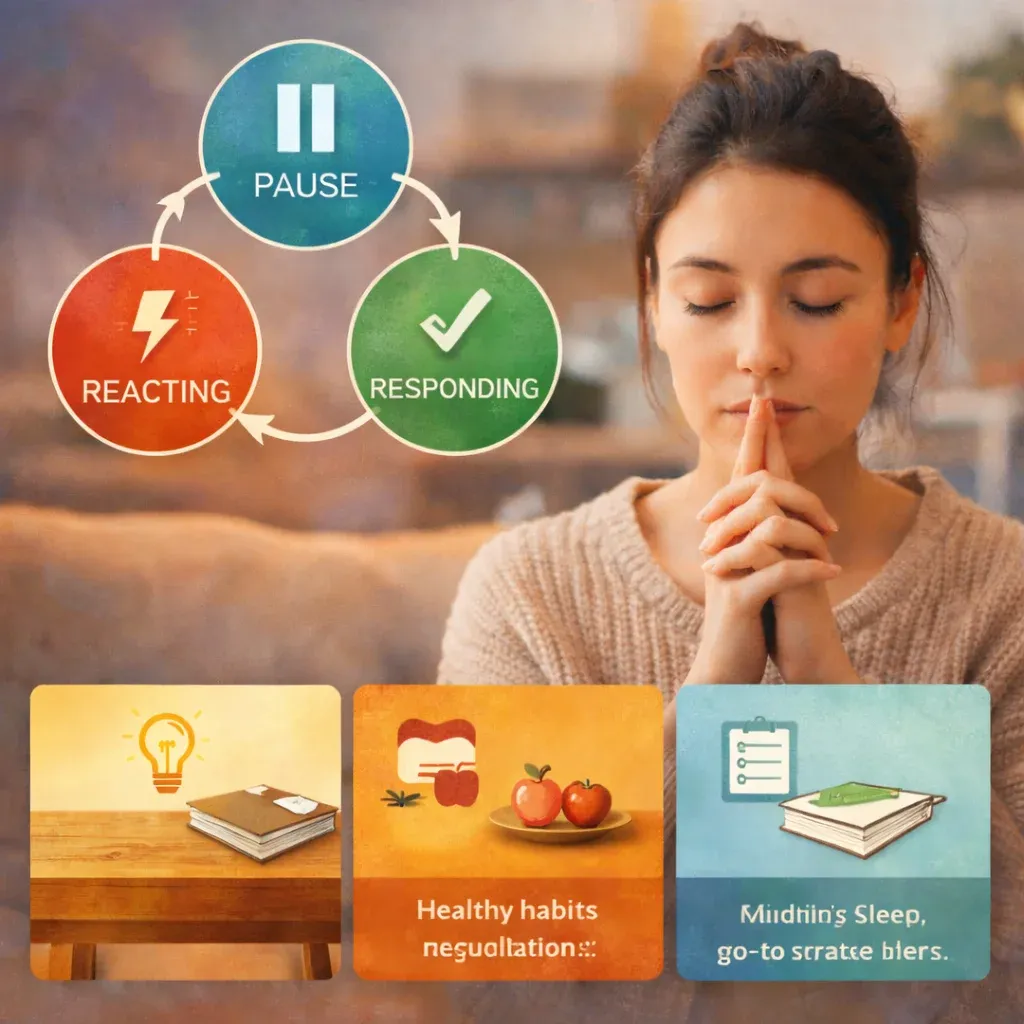
Many people interpret “losing control” as a character flaw, blaming it on a lack of discipline or willpower. In reality, what looks like raw willpower is actually a set of learnable self-regulation skills—the ability to notice what’s happening inside your body, pause, and choose your next move. When these vital coping mechanisms are under strain, it is incredibly easy to snap, shut down, procrastinate, overeat, overwork, or act impulsively. This is especially true during high-stress transitions like adolescence, moving to a new city, or navigating a massive career shift.
Signs Your Self-Regulation Skills Are Under Strain
When your system is running on empty, emotional control is usually the first thing to slip. You might find that:
-
You feel constantly on edge and react to minor frustrations much faster than you want to.
-
You struggle to stop an activity once you start (like doom-scrolling, emotional snacking, overworking, or arguing).
-
You know exactly what you should do, but you cannot reliably get yourself to follow through.
-
You feel a deep wave of regret right after an emotional outburst, a sudden shutdown, or an impulsive decision.
-
You are a parent, partner, or busy professional who simply wants to keep steadier, calmer responses under pressure.
The Two Core Components of Behavioral Regulation
In human language, building reliable self-regulation skills depends entirely on two internal capacities working hand-in-hand:
-
Pause-and-choose (Voluntary Action): The absolute ability to interrupt an intense, automatic impulse and consciously select a response that actually matches your long-term life goals.
-
Self-reflection (Your Inner Mirror): The ability to quietly notice what you are feeling, what you truly need in that moment, and what old behavioral pattern you might be repeating—without attacking yourself for it.
Why Gaps in Your Self-Regulation Skills Show Up Under Stress
Under sudden stress, your brain naturally prioritizes speed and basic safety over nuance. This is exactly why major life transitions—such as adapting to new schools, moving for family, or entering parenthood—frequently reveal behavioral “gaps” you never noticed before. It is not a sign that you suddenly became incapable. It simply means your nervous system is working overtime with far fewer resources like sleep, predictable routines, time, and emotional support. If you are experiencing this because of a major move, coordinating your coping strategies with tailored cultural transition therapy can help you anchor yourself.
3 Daily Practices to Strengthen Your Self-Regulation Skills
Just like training a muscle, you can sharpen your nervous system’s capacity to handle stress by introducing small, repeatable adjustments to your daily life:
-
The 10-second check: Before you speak or act on an impulse, gently ask yourself: “What am I actually feeling right now? What am I trying to protect? What do I want the ultimate outcome to be?” Even if you cannot instantly change the heavy emotion, naming it creates a vital psychological breathing room.
-
Reduce the system activation load: Your emotional control improves dramatically when your basic biological needs are met. Protect your sleep, baseline nutrition, and physical movement. Choose one tiny, repeatable stabilizer to anchor your day, such as a 10-minute afternoon walk, a consistent bedtime window, or a simple 2-minute breathing practice.
-
Build a proactive response menu: When your nervous system is highly activated, your brain loses the ability to invent a perfect coping strategy on the spot. Instead, prepare 3 to 5 easy, go-to responses in advance: take a purposeful pause, explicitly ask for a 5-minute break, write down your angry thoughts, step completely outside, or use a physical grounding cue (like placing your feet flat on the floor and taking a slow, deep exhale).
How Professional Therapy Can Help You Adapt
If your everyday stress has started deeply impacting your sleep quality, mood, relationships, self-confidence, or performance at work, you do not have to struggle through it alone. Working with a professional gives you a safe space to map out your unique triggers and build custom tools that fit your specific nervous system.
Depending on what you are walking through, a clinical care plan often integrates practical CBT skills, targeted emotion regulation strategies, somatic grounding, and structural planning for high-stress contexts like workplace conflict, parenting, or complex lifestyle shifts. Practicing these vital self-regulation skills with professional guidance helps you step out of survival mode and reclaim your peace of mind.
Frequently Asked Questions About Emotional Control
Is self-regulation the exact same thing as self-control?
Not quite. While traditional self-control is a small part of it, practicing true self-regulation skills is much broader—it also includes deep self-awareness, active self-compassion, physical recovery, and the ability to return your body back to a calm baseline after a stressful event.
What if I grew up without good models for emotional regulation?
That is incredibly common. According to extensive neuroscientific research published by the National Institutes of Health (NIH), because these are behavioral habits rather than fixed personality traits, these skills can be successfully learned, practiced, and mastered at absolutely any age with the right guidance and support.
Can my emotional responses improve quickly?
Many people notice an encouraging sense of relief early on simply by learning how to interrupt their automatic physical patterns. However, creating deep, lasting emotional change is a journey that builds up over time through repetition and supportive lifestyle shifts.
Next Step: Move From Reacting to Responding
If you want to feel steadier in your emotions, experience fewer impulsive reactions, and build real follow-through on your goals, we are here for you. Consider calling us directly at (437) 367-0700 to schedule a brief initial consultation. Together, we can talk about what you are experiencing and design a supportive, skills-based therapy plan that aligns perfectly with your lifestyle.